Enterprise Web Applications
Build responsive business systems for operations, case management, approvals, service delivery, reporting, and internal administration.
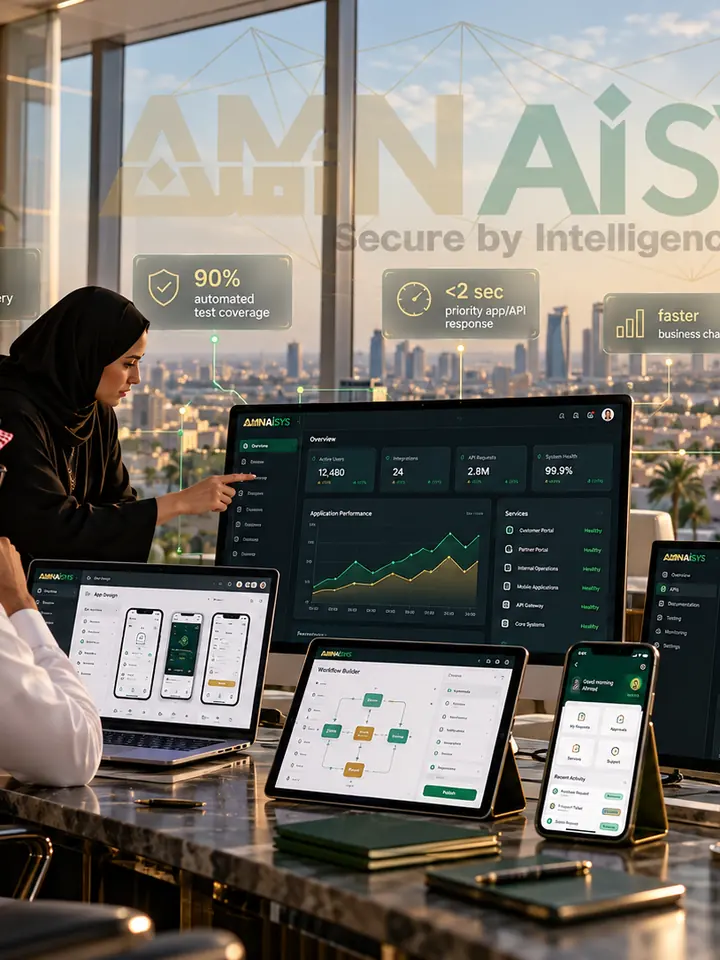
Design and build secure business applications, operational platforms, portals, and mobile experiences around the workflows that actually run the organization.
AMNAISYS turns operational requirements into maintainable software with clear architecture, secure integrations, controlled delivery, and interfaces designed for the people who use them every day.
Build responsive business systems for operations, case management, approvals, service delivery, reporting, and internal administration.
Create secure self-service portals that connect customers, suppliers, or partners to the right data, workflows, documents, and service requests.
Deliver mobile experiences for field teams, customers, inspections, approvals, task execution, and operational visibility across iOS and Android.
Replace fragmented spreadsheets and manual trackers with focused applications designed around real roles, permissions, data, and business rules.
Connect new software to ERP, CRM, identity, payment, data, and third-party platforms through secure and documented service interfaces.
Modernize aging applications through modular architecture, interface renewal, API enablement, containerization, and phased replacement of high-risk components.
Software is engineered for maintainability, security, integration, and controlled change so the platform can evolve with the business instead of becoming another rigid legacy system.
Clarify users, business processes, functional priorities, integrations, data needs and measurable product outcomes.
Design application boundaries, APIs, security, data flows and user journeys, then validate critical interactions early.
Develop in controlled increments with code review, automated testing, secure integrations and release-ready documentation.
Deploy through controlled environments, monitor production behavior and improve the product as business requirements change.
Model the product around actual roles, rules, approvals, and exceptions instead of forcing teams into generic workflows.
Use modular architecture, automated tests, and controlled delivery practices so new requirements can move into production with less disruption.
Create clear code structure, documentation, observability, and ownership so the platform remains supportable after the first release.
Integrate applications with identity, ERP, CRM, data, payments, and operational systems so the new platform becomes part of the business instead of another silo.
Focused solution patterns show how the capability can be applied to real operational priorities.
Build a secure internal platform that unifies workflows, approvals, operational data, reporting, and role-based access for core business teams.
ExploreCreate a self-service digital channel for requests, documents, status tracking, transactions, and controlled access to business information.
ExploreModernize high-value legacy applications through phased architecture renewal while preserving business continuity and critical integrations.
ExploreSERVICE FAQ
Yes. The first step is to assess architecture, code quality, integrations, user journeys and operational constraints, then decide whether targeted modernization, re-platforming or selective rebuilding offers the best path.
The scope can include enterprise web applications, internal platforms, customer and partner portals, mobile applications, workflow tools and API-backed services.
Security, identity, data boundaries and integration contracts are designed into the architecture, with automated testing and controlled release practices used during implementation.
Yes. Ongoing work can include monitoring, maintenance, enhancements, performance improvements, release management and integration support.
Translate the operational requirement into a clear product scope, architecture, integration plan, and implementation path with AMNAISYS.